The written report from our two-part workshop series on data management plans for language data is now available on Zenodo, alongside the slides and recordings from both sessions.
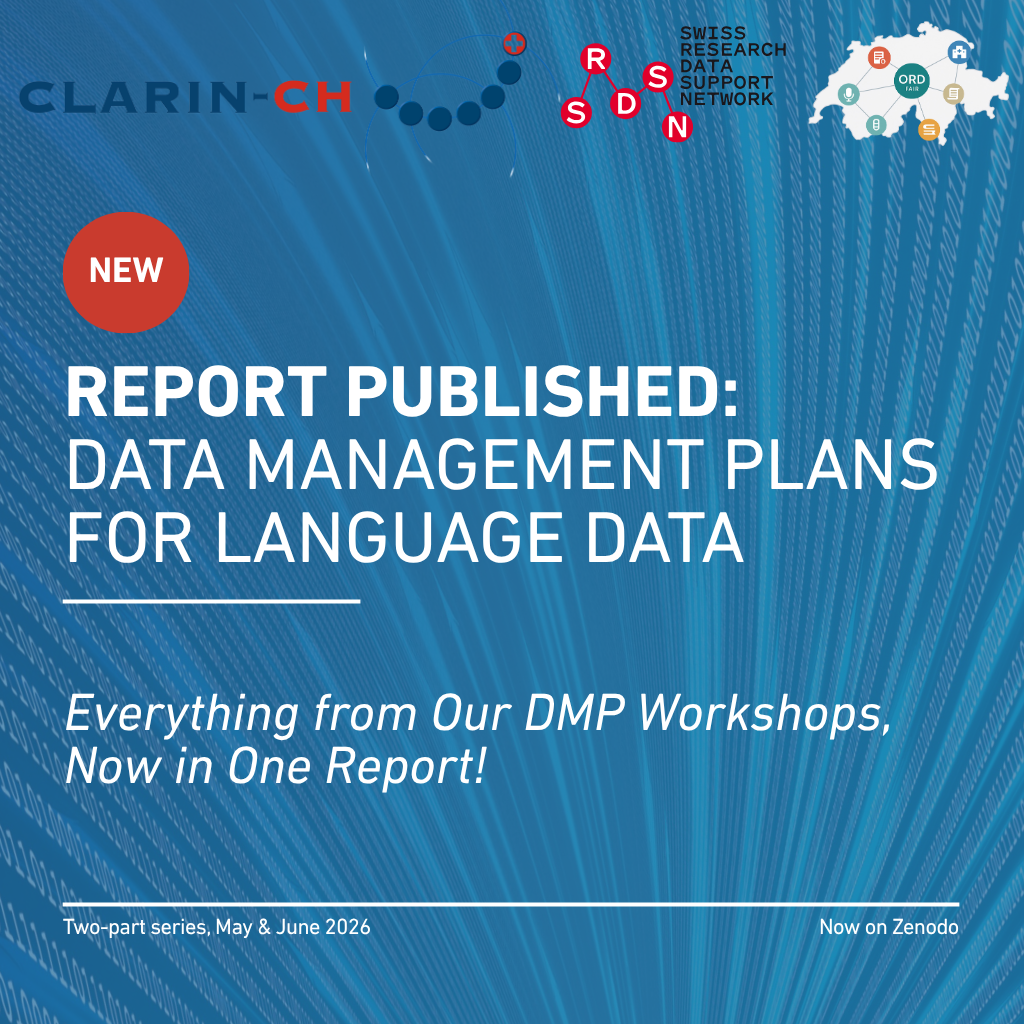
Writing a good data management plan (DMP) is one of the most useful things a researcher can do early in a project, and it is increasingly a funding requirement rather than an option. To help researchers working with language data get it right, CLARIN-CH ran a two-part online workshop over spring and summer 2026. The full written report is now published, and this news item points to all the resources.
Why the workshop mattered
Language data is harder to manage than most. Formats are heterogeneous, from text to audio to video and multimodal recordings. Metadata requirements are demanding, since annotations must themselves be documented. Audio and video often contain personally identifiable information that cannot be fully anonymised, and interoperability depends on standards that only the relevant research communities maintain. Generic DMP guidance rarely tells a researcher what to do for language data specifically.
The series was designed to close that gap. Part I (4 May 2026) explained why a DMP shapes the whole research design and what the Swiss National Science Foundation expects, and introduced the Data Stewardship Wizard as a practical tool for building plans. Part II (29 June 2026) worked through five real, anonymised DMPs covering speech data, large textual data, experimental data involving minors, cross-country sociolinguistic interviews, and sign language data, turning each into concrete, section-by-section recommendations.
The workshops brought together the SNSF, the Swiss Institute of Bioinformatics, the Swiss Research Data Support Network, and researchers, data stewards, and legal experts from several Swiss universities. Around 100 people registered.
What the report covers
The report follows the two sessions and, within Part II, is ordered by the sections of a DMP, so each part can be read on its own and applied directly to your own plan. It covers data collection and documentation, legal and ethical aspects, storage and security, preservation and archiving, and data sharing and reuse. For language data, the report points to LaRS@SWISSUbase as the Swiss repository and the CLARIN CMDI metadata standard.
Access the resources
The written report, slides, and recordings from both sessions are available on the CLARIN-CH Zenodo Community.