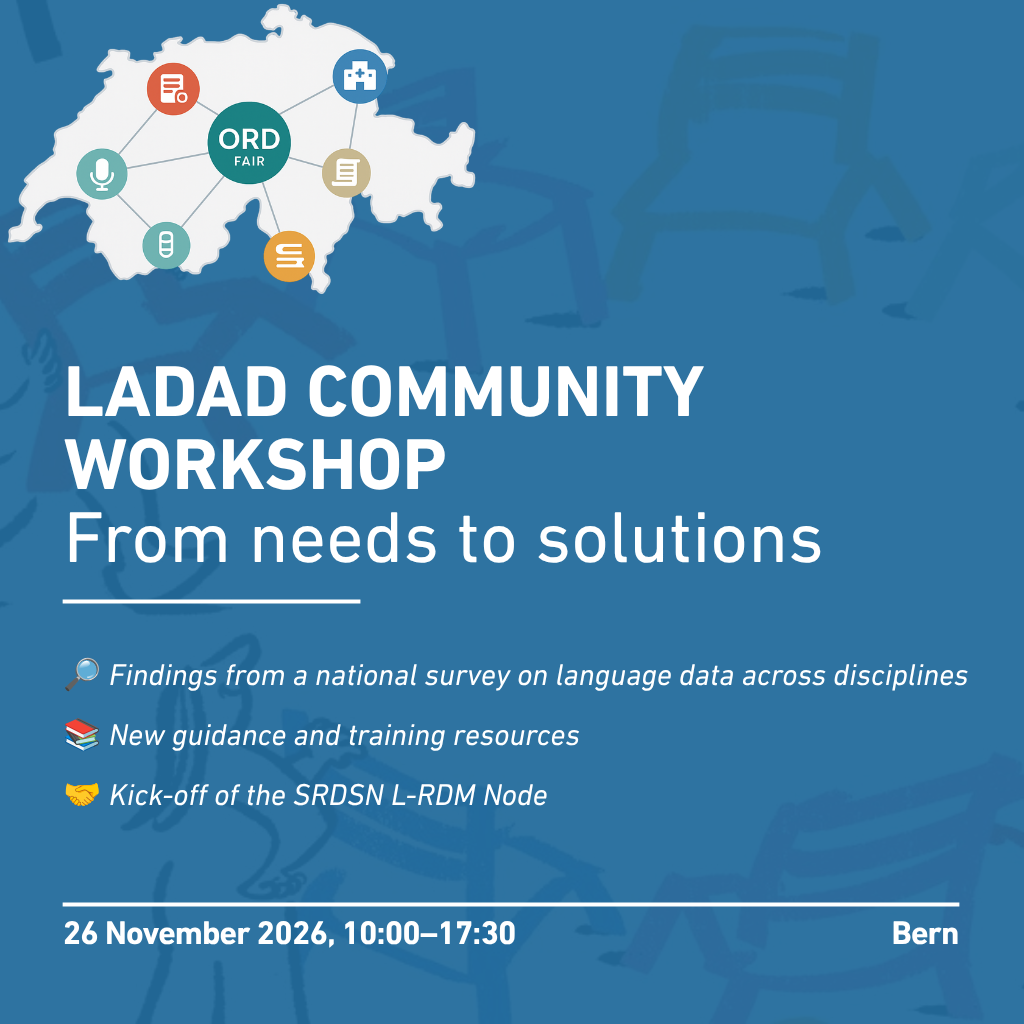
On 26 November 2026, the LaDaD project — Language Data Across Disciplines — will host its community workshop at the University of Bern (Room S 201, UniS, Schanzeneckstrasse 1, Bern) from 10:00 to 17:30. The workshop marks the end of the project, which was co-funded through the swissuniversities Open Science II programme, and brings together project partners, data stewards, and researchers from across disciplines to look at what has been built and what comes next.
LaDaD set out to answer a set of practical questions. How are language data used across disciplines? What challenges do researchers face when managing, analysing, sharing and preserving these data? And where can researchers turn when they need support? The workshop will present the project’s findings and outputs, and open a wider discussion about the future of language data management in Switzerland.
What to expect
Insights from the disciplines — Findings from our interviews with disciplinary experts and our national survey, showing how researchers beyond linguistics work with language data, and what they need most.
New resources — A first look at what LaDaD has built: legal and ethical guidance, and a catalogue of training resources for researchers and teachers.
Tools & practical workflows — Examples of language-data infrastructures and NLP methods in action, showing what they can offer research beyond linguistics.
Building a sustainable community — The kickoff of the SRDSN Language Research Data Management (L-RDM) Node, a new community connecting researchers, data stewards and ORD specialists working with language data.
Programme
| Time | Contribution | Description |
|---|---|---|
| 10:00–10:15 | Welcome and introduction (CLARIN-CH) | Language data matter far beyond linguistics. As LaDaD draws to a close, we start the day with a simple question: what do researchers working with language data need, and where can they turn for support? |
| Part I – Where do we stand and what do researchers need? (10:15–11:15) | ||
| 10:15–10:45 | From the field: insights from the disciplinary interviews (CLARIN-CH) | Linguists are not the only ones working with language data. Interviews with experts from different disciplines show how these data are used, how far open and FAIR practices have taken hold, and where researchers run into obstacles along the data life cycle. What do the disciplines have in common, and where do their needs diverge? |
| 10:45–11:15 | From the community: results of the national survey (ZHAW) | What do researchers across Switzerland know about their language data, and what do they do with them? The national survey sets linguistics side by side with other disciplines and uncovers skills and infrastructure gaps, everyday challenges, and the training and support researchers wish for. What does this mean for the future of ORD support? |
| Part II – From project to results (11:15–12:00) | ||
| 11:15–11:45 | The LaDaD Legal & Ethical Resources: Decision Trees (ccdigitallaw) | Which rules apply to my recordings, and what should I consider before sharing them? Legal and ethical questions are among the biggest stumbling blocks when working with language data. The LaDaD decision trees guide researchers step by step to the answers, using concrete use cases, and are designed to stay useful well beyond the project. |
| 11:45–12:00 | Finding the right resource: the catalogue of training resources (CLARIN-CH) | With so many courses, tutorials and guides out there, where do you even begin? The CLARIN-CH catalogue brings training resources together in one place. This short presentation shows what is available, how the catalogue is organised, and how researchers and teachers can put it to use. |
| 12:00–13:30 · Lunch and networking | ||
| Part III – From the LaDaD project to a sustainable support community (13:30–14:30)How to sustain the knowledge, resources, expertise and community created by LaDaD. | ||
| 13:30–14:00 | Kick-off of the SRDSN L-RDM Node, Part I (SRDSN, CLARIN-CH) | Where do I go when I need help with my language data? The SRDSN Language Research Data Management (L-RDM) Node grew out of what LaDaD heard from the community: a long-term home where researchers and data stewards can find advice and connect with one another. This session marks its kick-off. |
| 14:00–14:30 | Kick-off of the SRDSN L-RDM Node, Part II: Annotated DMPs as pilot output (SRDSN, CLARIN-CH RDM WG) | Data management plans do not have to stay abstract. Annotated DMPs offer practical guidance for language data, and this pilot output of the node’s work shows what they look like and how they can help researchers get started. |
| Part IV – From research questions to data pipelines (14:30–16:30) | ||
| 14:30–15:00 | Case study 1: An end-to-end language-data pipeline from audio to structured data (UZH DSI) | How do you get from a research question to data you can actually reuse? This case study follows one language-data pipeline from start to finish, turning raw audio into structured, reusable data through transcription, topic modelling, named entity recognition, annotation, RAG-based querying and JSON export, all within a reproducible workflow. |
| 15:00–15:30 · Coffee break | ||
| 15:30–16:00 | Case study 2: From raw text to corpus — building practical NLP workflows for data enrichment (UZH LiRI) | Demonstrates a practical workflow from raw text to a prepared collection of files ready to be imported as a corpus (e.g. into the LiRI Corpus Platform). Methods include anonymisation, topic modelling, named entity recognition, lemmatisation and part-of-speech tagging. |
| 16:00–16:30 | Case study 3: Manual annotation in learner corpora (ZHAW) | Behind every annotated learner corpus lies careful manual work. This case study offers a look at how manual annotation is done in learner corpora and what it means for researchers working with learner language. |
| 16:30–17:00 | Closing discussion and looking ahead: From LaDaD to a sustainable language-data community | LaDaD may be coming to an end, but the work does not stop here. What have we learned, and which resources can researchers use from now on? What support will they need next, how can the SRDSN L-RDM Node carry the work forward, and how can each of us contribute? |
From LaDaD to what comes next
The project itself is ending, but the resources, community and support structures it helped set up will continue through the L-RDM Node and its partners. The workshop is a chance to review what LaDaD has learned, see the outputs, and shape where the work goes from here.
Language Data Across Disciplines (LaDaD) — Advancing FAIR Open Research Data Practices in Switzerland